

Introduction to AI Agent Security
Check Point AI Agent Security secures the AI applications and agents your organization builds and deploys. It discovers agents across the platforms where they run, assesses the risk of each agent’s configuration, and protects them at runtime through AI Guardrails. Leading enterprises and fast-growth SaaS companies use Check Point to secure all of their GenAI applications.
What’s in the product
- Agent discovery: connect the agent platforms and cloud infrastructure you use — Amazon Bedrock and AgentCore, Google Cloud, Microsoft Copilot Studio, Salesforce Agentforce, n8n, and Relevance AI — and build a continuously updated inventory of agents, their tools, and connected MCP servers. See Agent Discovery.
- Risk assessment: every discovered agent gets a holistic risk rating with the contributing factors explained, plus a risk-types view across all agents mapped to OWASP and MITRE ATLAS. See Agent Risk Assessment.
- AI Guardrails runtime protection: real-time detection and flagging of prompt attacks, data leakage, content violations, and off-policy agent behavior through the Guard API, covering the full agentic workflow including tool calls, tool responses, and tool descriptions.
Tiers
- AI Agent Security: discovery, risk assessment, and runtime protection. Includes everything in AI Guardrails.
- AI Agent Security - AI Guardrails: the runtime layer on its own, available standalone for teams that want to embed Check Point’s detection directly into their own AI applications.
Defenses
AI Guardrails will screen LLM interactions and flag for mitigating action if the following threats are detected:
- Prompt attacks - detect prompt injections, jailbreaks or manipulation in user prompts, reference materials, tool responses or tool descriptions to stop LLM behavior being overridden
- Data Leakage - prevent leakage of sensitive information and Personally Identifiable Information (PII) in user prompts or LLM outputs
- Content violations - detect offensive, hateful, sexual, violent and vulgar content in user prompts or LLM outputs
- Malicious links - detect links that are not from an allowed list of domains to prevent phishing and malicious links being shown to users
- Off-policy agent behavior - detect dangerous actions outside the agent’s trusted mandate with the Dangerous Deviation detector, and control which tools an agent may call with the Tool Allow/Deny List
- Custom threats - create custom controls to apply your own security policies
Note that the configured detectors will always detect attacks, but flag only in Enforce mode. You can control that by changing the Project mode.
You can also control and customize the defenses applied to your application or use case by setting policies within AI Guardrails.
How it works
AI Guardrails is built on top of our continuously evolving security intelligence platform and is designed to form a protective firewall around your generative AI applications, securing LLM interactions in real time.
Integrating with AI Guardrails is straightforward and can be done in minutes:
- Simply set up a project for each application or system you need to secure.
- For each project, choose a policy from our catalog or create a custom policy to enforce your bespoke security requirements.
- Then have your AI gateway or GenAI application(s) make an API request to the Guard API for each user interaction or agent step, passing the user and external inputs plus the LLM output to AI Guardrails.
- Using Project mode, flexibly choose how your applications respond if AI Guardrails flags a threat, for example blocking the interaction or logging for investigation.
AI Guardrails will now continuously screen for attacks, unwanted AI behavior, and data leakage according to your policies, protecting your GenAI applications in real-time and providing visibility of threats and vulnerabilities.
Once integrated, you can configure and customize AI Guardrails to control application and use-case specific defenses across your organization. Gain centralized oversight and rapidly respond to threats and suspicious users through in-built monitoring, or connect up your own security monitoring setup.
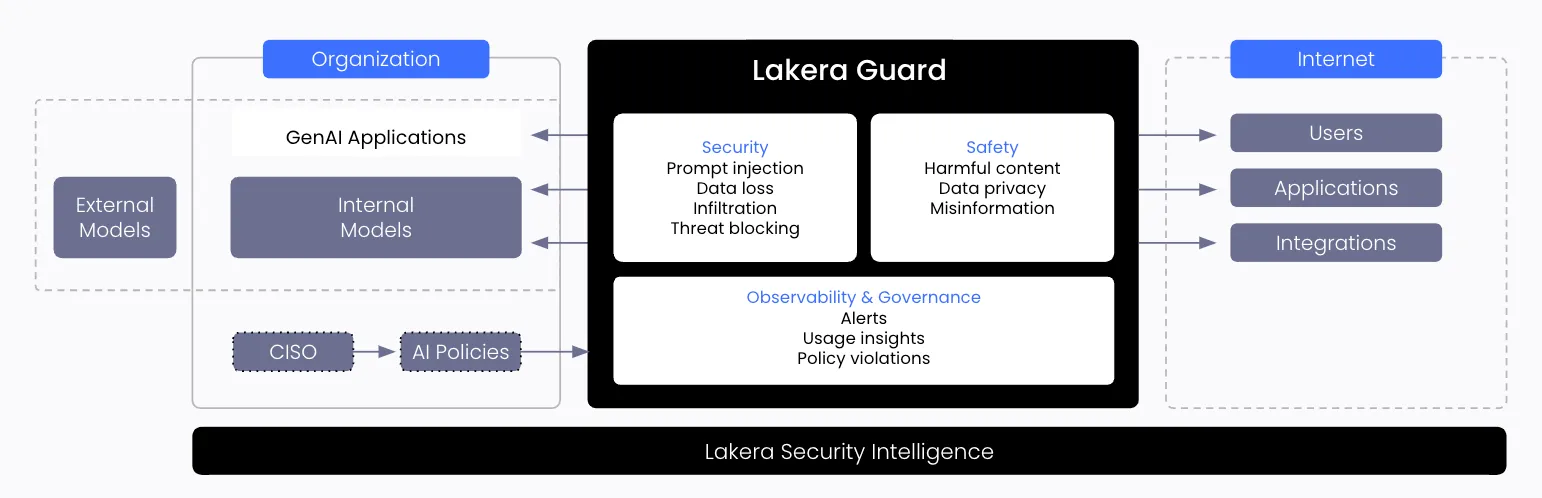
Continuously evolving threat intelligence
Our security intelligence platform combines insights from public sources, data from the LLM developer community, our AI Red Teaming team, and the latest LLM security research and techniques.
Our proprietary threat database contains tens of millions of attack data points, and is growing by roughly 100,000 entries per day, so you can gain zero day protections and stay ahead of constantly arising new threats.
Coverage
Model compatibility
AI Guardrails is completely model-agnostic and works with:
- Any hosted model provider (OpenAI, Anthropic, Cohere, etc.)
- Any open-source model
- Your own custom or fine-tuned models
Language
Check Point detects threats in 100+ languages, including all major global languages, including:
- Major European languages (English, French, German, Spanish, Italian, etc.)
- Asian languages (Chinese, Japanese, Korean, Vietnamese, Thai, etc.)
- Indian languages (Hindi, Bengali, Tamil, etc.)
- Arabic and other Semitic languages
- Russian and other Slavic languages
- African languages (Swahili, Yoruba, etc.)
Modalities
AI Guardrails screens for threats in text, including structured text as well as natural language.
Audio Defense screens audio input for prompt attacks and is available in Early Access. See Audio Defense. Defense against threats in images is coming soon; reach out if you want to join the early access beta.
Deployment options
AI Guardrails is available as an enterprise grade Software as a Service (SaaS) cloud-hosted solution or Self-hosted product.
| Capability | SaaS | Self-hosted |
|---|---|---|
| Guardrail policy configuration | Web UI with unified policy management. | Configuration via json files on S3 compatible storage |
| Automated policy management | Platform API for automated policy and project management. | Customer-managed policy management. |
| Security model calibration | Automatic, platform-managed model calibration tailored to each application. | Tailored via customer-managed template extraction and policy configuration. |
| Security model evolution & learning | Daily base model updates, with customer-specific adaption for reported misclassified requests. | Base models updated at least every stable release (bi-weekly). Ability to update models with the latest threat data from nightly builds. |
| Custom guardrails | Beta access. Define and fine-tune precise custom security and content controls in natural language. | |
| Audio defense | Early Access. Screening of audio inputs for spoken prompt injections and audio-based attacks; enabled per organization. | Screening of audio inputs for spoken prompt injections and audio-based attacks. |
| Request & Event Logs | Full logging support, accessible via dashboard web UI. SIEM integration available. | Support for third-party or in-house logging systems via structured logs written to stdout and metrics endpoints. |
| Analytics | Real-time analytics, monitoring & investigations via dashboard web UI. | Support for third-party or in-house observability stacks (e.g. Grafana, ELK) via structured logs written to stdout and metrics endpoints. |
| Testing and Experimentation | Web-based playground for interactive testing and validation. | Testing usually via customer-managed UAT environments. |
| Scalability & performance | Horizontally scalable, low-latency architecture with cost-efficient autoscaling. | Customer-managed scaling and performance optimization in collaboration with Check Point’s engineering team. |
| New features | Early-access support for new features and improvements. | Features released after additional stability verification period. |
Get started for free in minutes
You can start protecting your LLM applications in minutes by signing up for a free account and following our Quickstart guide.
Learn more
- Explore agent discovery and risk assessment, the posture layer of AI Agent Security
- Understand the AI threats that GenAI applications face and how Check Point defenses secure against them
- Learn more about working with the Guard API
- Learn more about how to use the AI Guardrails Dashboard to monitor and analyze interactions and threats, as well as customize and configure AI Guardrails